
Habermas and Confucius
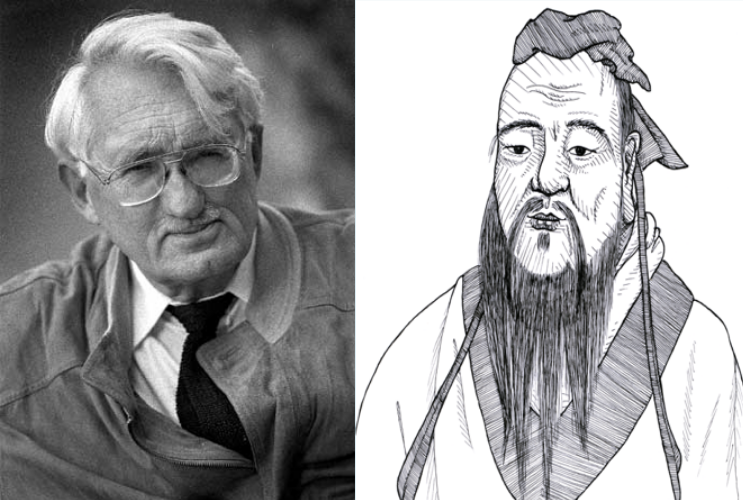
In December 1992 I was invited by Jürgen Habermas for a one-to-one meeting in his office at Goethe-Universität in Frankfurt. This conversation quietly influenced the direction of my later research on deliberative democracy in China (along with James Fishkin, Robert Luskin and Alice Shu). I introduced the Chinese philosopher Liang Shuming and asked about the relationship between Liang’s moral conception of communication and Habermas’s theory of communicative rationality. Habermas listened carefully, asked about Liang’s intellectual background, and then explained why he regarded his own theory as more systematic and procedural. My later meeting with sinologist Dr. Heiner Roetz reinforced this point. Roetz explained how Confucian ideas such as ren (humaneness), yi (rightness), and shu (reciprocity), could provide moral resources for democracy. He rejected the assumption that Confucian political thought is inherently authoritarian and argued that it contains resources for public reasoning, criticism of political power, and universal standards of justice. During his visit to China in 2001, Habermas acknowledged that he was not a specialist in Confucian thought, although he suggested that Mencius (a disciple of Confucius) might offer resources for thinking about moral autonomy and public reason.
Habermas’s interest in Chinese democratisation remained with me. During fieldwork on village elections in rural China in 1995 and 1996 I encountered the practice of ‘heart-to-heart talks’ among villagers. These conversations reminded me of both Liang’s account of moral communication and Habermas’s theory of communicative rationality. Liang had imagined rural governance as a practice of dialogue, community participation, ethical cultivation, and collective problem-solving. The deliberative experiments that emerged in rural China during the 1990s and 2000s were not direct implementations of his programme, but they can be understood as partial echoes and contemporary adaptations of it.
This position differs from approaches that give sortition a more constitutive role. James Fishkin’s Deliberative Polling, introduced in Zeguo Township in 2005, selected citizens randomly to consider local budget priorities. Sortition created a socially diverse body whose members could receive information, question experts, exchange reasons and form considered judgements. Fishkin treats random sampling as indispensable because it allows the forum to approximate an informed microcosm of the citizenry (Fishkin et al. 2010). Habermas places greater weight on the quality and circulation of communication throughout the political system. Hélène Landemore (2020) similarly assigns a more central democratic role to inclusive forms of citizen selection than Habermas does.
Looking back, the value of my 1992 encounter with Habermas lies less in any settled conclusion than in the questions it opened. Four remain especially important to my work: how communication can cross philosophical and civilisational traditions; whether random selection strengthens democratic legitimacy; how collective decisions should be made when deliberation does not produce consensus; and whether public reason can survive its growing mediation by digital platforms and artificial intelligence.
Habermas has left us, but the questions at the centre of his philosophy have become more urgent. In a world divided by war, geopolitical rivalry, digital fragmentation and algorithmic power, can people continue to resolve common problems through public reasoning rather than violence or coercion? His answer was to continue the conversation. Experience suggests that dialogue also requires fair institutions for representation, decision, accountability, and revision. The enduring task is to hold these elements together without surrendering the hope that people can still listen to one another, learn from disagreement, and act on reasons they can share.
Read the full paper here.
Responses (13)
Join the discussion. Comments are open to all and are reviewed by an editor before they appear.
Baogang is best known for his work (with James Fishkin) on Deliberative Polling in Zeguo, China. This paper (strongly recommended) provides a fascinating cross-cultural perspective on some of the philosophical issues involved.
ReplyBaogang, thank you for this lovely and insightful piece. I am personally working through Between Facts and Norms for my first time, so this came at a very suitable moment for me. It's fascinating and exciting to me how increasingly celebrated we are seeing communication become, particularly in a time in which communication is becoming increasingly strained. I think the goal of inserting deep and honest communication into the fabric of society is not only an honourable one, but a neccesary one, and Habermas' work speaks powerfully to that goal.
ReplyJordan:> I think the goal of inserting deep and honest communication into the fabric of society is not only an honourable one, but a necesary one, and Habermas' work speaks powerfully to that goal. In his 2023 book, which Baogang references, Habermas moves on from his previous focus on the ideal speech situation to the need for exposure to “competing public opinions” (p. 71). The “informed pluralism of opinion filtered by the media system” (p, 15) and protected by “a professionalised staff that plays the gatekeeper role” (p. 31) has deteriorated into a “desolate cacophony in fragmented self-enclosed echo chambers” (p. 37). The echo chambers of the new media are, if anything, more deliberative than their MSM predecessors, as all participants are free to pitch in with comments, albeit limited to 280 characters (X) or 1,000 characters (Instagram). The problem is an absence of information/opinion diversity rather than a lack of speech rights. Social media are funded purely by advertising, and clickbaiting is inherently polarising. Traditional (MSM) were partially funded by subscriptions and this encouraged publishers and editors to offer a broader range of information and opinions in order to attract more subscribers. Perhaps the state could play a role in returning to a subscription model by providing citizens with a bursary that they could allocate to their preferred media outlet? The alternative would be so-called “public” media, but the BBC (for example) has been accused of unconscious bias and the competing biases of a range of commercial media might work better (on aggregate). Needless to say this assumes that most citizens are listeners, rather than speakers. According to Daniela Cammack’s forthcoming book this was the case in the most “deliberative” organ of Athenian democracy, the Council of 500.
ReplyFor examples of "competing biases" take a look at the variety of front pages of UK newspapers: https://www.bbc.co.uk/news/articles/cm3el33kvn3wo
ReplyKeith > The problem is an absence of information/opinion diversity rather than a lack of speech rights. I don't disagree that there is a problem with lack of speech rights. However, my concern is a lack of communication. Exposure to different perspectives is only one element of the current problem, though I do agree it is a piece of it. However, having to explain yourself to different perspectives is also just as important, in my opinion. It's easy to read a piece you disagree with and find reasons to dismiss it. It's harder to read a piece you disagree with and find reasons to dismiss it that will convince people on the other side that it deserves dismissal. There is continued value in a democracy of having each side justify themsevles to the other, rather than only needing to justify their stances to those one the same side. I am, myself, a firm believer in deliberation between members of varying perspectives.
ReplyFrom my experience on other forums, needing to provide reasons for or against one's own views only deepens the confirmation bias. Deliberative democrats should focus more on how best to listen to and evaluate the speech acts of others. I would be surprised if the empirical literature on deliberation in deeply-divided societies demonstrated that it was the exchange of reasons (as opposed to empathetic listening) that moderated beliefs and preferences.
ReplyKeith > I would be surprised if the empirical literature on deliberation in deeply-divided societies demonstrated that it was the exchange of reasons (as opposed to empathetic listening) that moderated beliefs and preferences. I think you are hitting on something valuable that we both agree on. I agree in empathetic listening, and I think there is, indeed, great value in that. While "the production of reaasons" certainly sounds cold, I think when done properly, and done in the way Habermas suggests in which participants are engaging in "communicative action" rather than "strategic action", empathetic listening is absolutely a significant element of it. We cannot produce good reasons to people we do not listen to. We cannot produce convincing arguments to people we do not understand. When we talk about deliberation in which various perspectives are working to produce arguments to justify to one another, the unspoken assumption underneath is that in order to do this, we must understand one another to know what might be convincing. And when we get to a point where we understand the other person and their reasons, and realize we have no reasons left to produce, we might find ourselves being convinced. I believe this process can work. I do believe there is a great deal of empirical evidence that backs this up. But, yes, I agree with you whole heartedly. Empathetic listening is critical to the entire process. I think it's valuable to make this explicit.
ReplyAs I stated, I'm currently reading through Between Facts and Norms. Still very early on, having to take it very, very slow and look up a lot as I go along. However, ironically, the page I'm currently reading speaks to this directly: > On the other hand, as soon as the illocutionary forces of speech acts take on an action-coordinating role, language itself supplies the primary source of social integration. Only in this case should one speak of "communicative action." In such action, actors in the roles of speaker and hearer attempt to negotiate interpretations of the situation at hand and to harmonize their respective plans with one another through the unrestrained pursuit of illocutionary goals. Naturally, the binding energies of language can be mobilized to coordinate action plans only if the participants suspend the objectivating attitude of an observer, along with the immediate orientation to personal success, in favor of the performative attitude of a speaker who wants to reach an understandingwith a second person about something in the world. Under this condition, speech-act offers can achieve an action-coordinating effect because obligations relevant to further interaction result from the addressee's affirmative response to a serious offer. When people are working towards a shared goal, and they cannot see one another as objects in their way to be overcome, but as perspectives that need to be understood. Only through mutual understanding, through the process of empathetic listening, can we provide responses that would be taken seriously.
ReplyAs Habermas (didn't) say, there's a big gap Between Facts and Norms. I'm more interested in how people actually engage in deliberation (rather than how they should). But I do agree with him that communicative action is the exception rather than the rule. I'd love to see your evidence that stronger reasoning (as opposed to empathetic listening) is doing the heavy lifting.
Reply> I'd love to see your evidence that stronger reasoning (as opposed to empathetic listening) is doing the heavy lifting. I hope you can be patient, as my second paper will be doing some heavy lifting on this question (though I'm writing my second and third simultaneously, so both are slow going). For now, I'll address it qualitatively. I don't think I can, or would, make the argument that rationality is a prerequisite in any way for empathetic listening. I think people naturally vary, and some are better empathetic listeners than others. I think it's also a skill that can be developed, like any other. However, I think that skills that occur more naturally in some aren't absent in others, but require more specific contexts to bring to the surface. We are all capable of active, empathetic listening, but the contexts of our lives (and our political systems) often discourage these acts. I think the act of engaging in persuasive deliberation is one of those contexts. Needing to convince a person requires you to actually understand a person. Providing reasons for your side without any understanding of who you are talking to is going to be a lost cause. If you want to convince someone to go to an Italian restaurant to you, but you don't know they are allergic to tomato, you are unlikely going to be able to provide convincing reasons to get them to go with you. The argumentative theory of reasoning makes this explicit. Argument production is lazy because the efficient way or producing reasons is to tailor it for your audience. You start with a weak argument, wait for objections, and then produce stronger reasons that address their specific objections. To be successful, this requires you to actively listen to the objections being made. This helps produce a mindset that leads to active, empathetic listening. This is particularly true in a context where you have a common goal you need to achieve (working out where to go to eat), compared to arguing in the abstract in which there is no consequence to failing to make a decision (arguing for decades in an online forum). Again, there are some, or perhaps many, in which they can engage in empathetic listening without this context, but I think it is a context that achieves gets us there for the greatest number of people.
ReplyGiven the purpose of the argumentative theory of reasoning is to convince others (rather than to arrive at the truth), it's a good example of strategic, rather than communicative action. I wonder if Helene Landemore and Habermas ever discussed the ATR, as I'm genuinely puzzled as to how it can integrate with a theory of communicative action.
Reply> Given the purpose of the argumentative theory of reasoning is to convince others (rather than to arrive at the truth), it's a good example of strategic, rather than communicative action. I disagree with this interpretation, and I think that's our fundamental disagreement. We are interpreting what "convincing others" means to the theory. In fact, the Enigma of Reason makes this explicit. On page 305, it's stated: > As the argumentative theory of reasoning might predict, “in a moral argument, we expect the successful rebuttal of an opponent’s arguments to change the opponent’s mind.” He goes on to explain why we might not always see this in action all the time: > When beliefs are not readily testable, it is quite rational to accept them on the basis of trust, and it is quite rational for people who trust diff er ent authorities to stubbornly disagree. The theory, according to it's author, predicts that when people of opposing views deliberate with the goals of convincing one another, they should be able to convince one another with sufficiently good arguemnts. Yes, the ATR argues that rationality is for convincing others, but it's also for being convinced. However, we will only be convinced with sufficiently convincing arguments (ie evaluation is critical). But the book also says explicitly what I said above, that reason production is lazy *because* doing so allows us to tailor our arguments towards their specific objections, ie actively listening to them. The authors even promote deliberative democracy explicitly: >When a sample of citizens is brought together, divided in small groups, and, with the soft prodding of a moderator, made to discuss policy, good things happen.33 The participants in these discussions end up better informed, with more articulate positions but also a 310 Reason in the Wild deeper understanding of other people’s point of view. Their opinions tend to converge toward a reasonable compromise. They are more likely to participate in public life in the future. Deliberation among citizens works. Referencing Fishkin's deliberative polling. The authors of the ATR are, from their perspective, explaining how deliberation is effective at changing people's minds.
ReplyI do think, however, that we should perhaps put a pin in this conversation or move it elsewhere, as this article was a beautiful tribute to Habermas, as well as a fascinating connection to non-Western thinkers. I think it would be best if we leave the space to commenters who wish to focus in on that.
Reply